
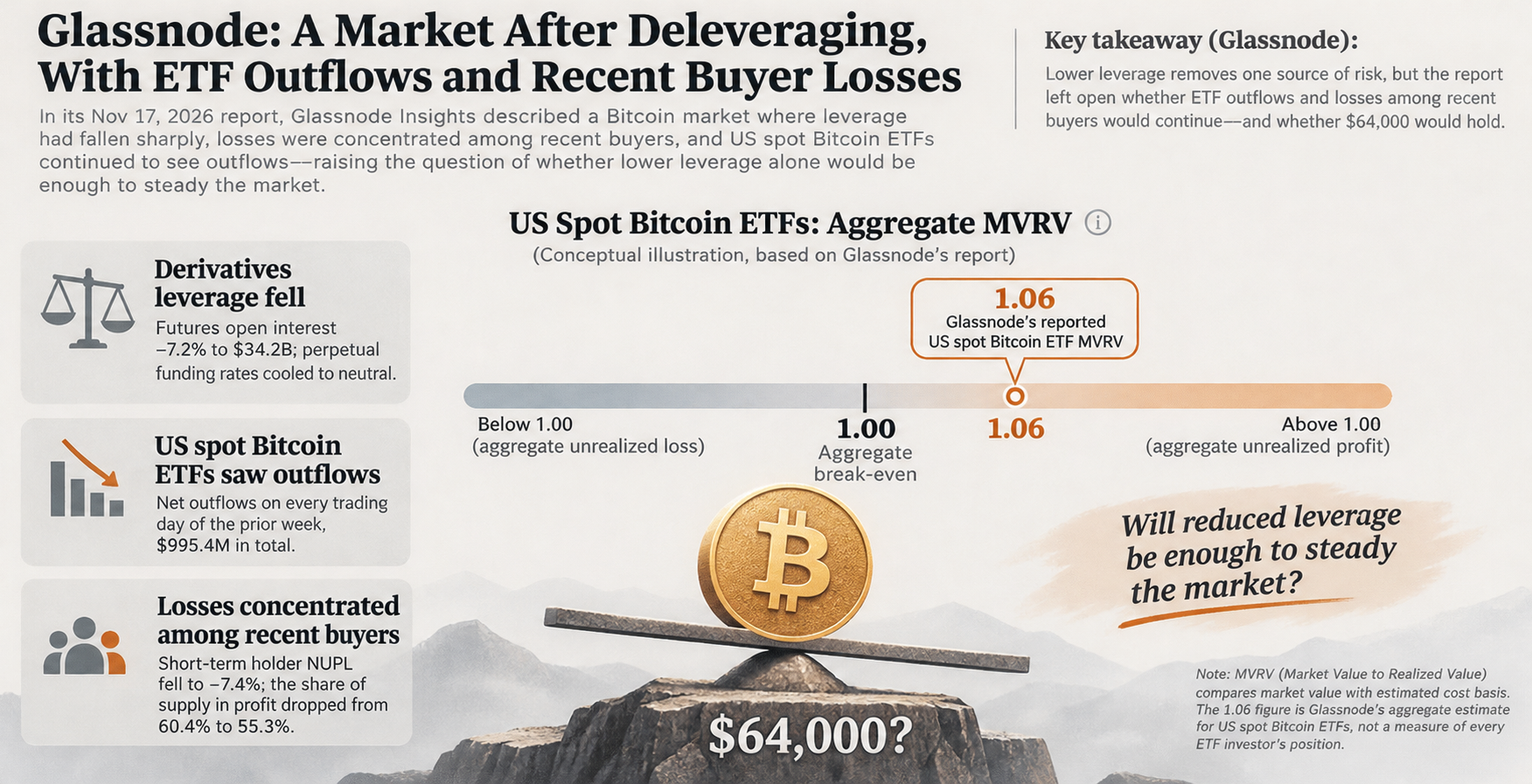
In a report published on November 17, 2026, Glassnode Insights described a Bitcoin market in which derivatives leverage had fallen sharply, while losses were increasingly concentrated among recent buyers. The question was whether reduced leverage would be enough to steady the market as US spot Bitcoin ETFs continued to see outflows.
Bitcoin was trading near $64,000 on the Monday covered by the report, after falling about 13% over the preceding week. It had briefly dropped below $63,000 on Saturday, its lowest level since late August.
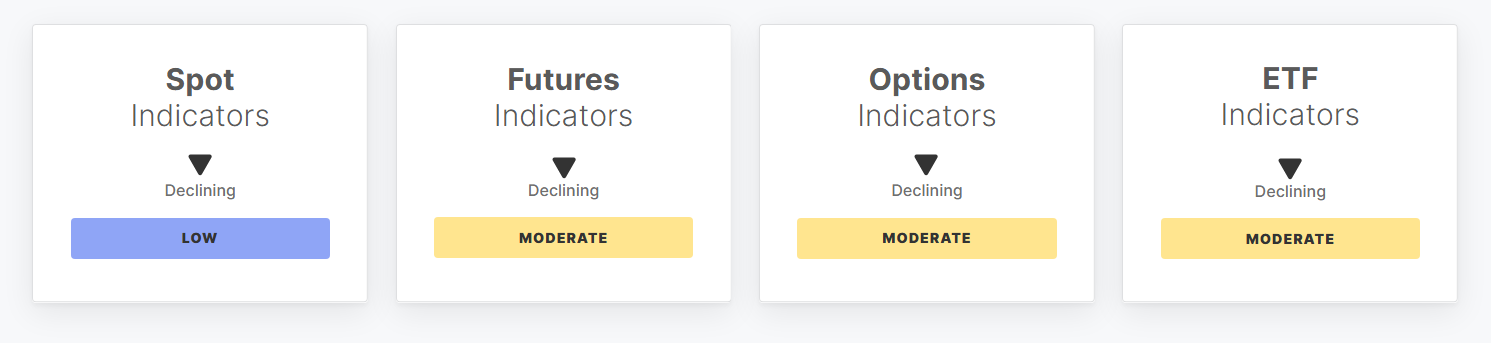
What had changed in the market?
Glassnode reported that futures open interest fell 7.2% from the prior week to $34.2 billion. Perpetual-futures funding rates also cooled from elevated levels into a neutral range. Those readings suggest that some leveraged positioning had been cleared, though they do not establish that selling pressure had ended.
US spot Bitcoin ETFs recorded net outflows on every trading day of the preceding week, with weekly net outflows of $995.4 million. Glassnode put the ETFs’ aggregate MVRV—a measure comparing market value with estimated cost basis—at 1.06, close to the 1.0 break-even level. That is an aggregate estimate, not a measure of every ETF investor’s position.
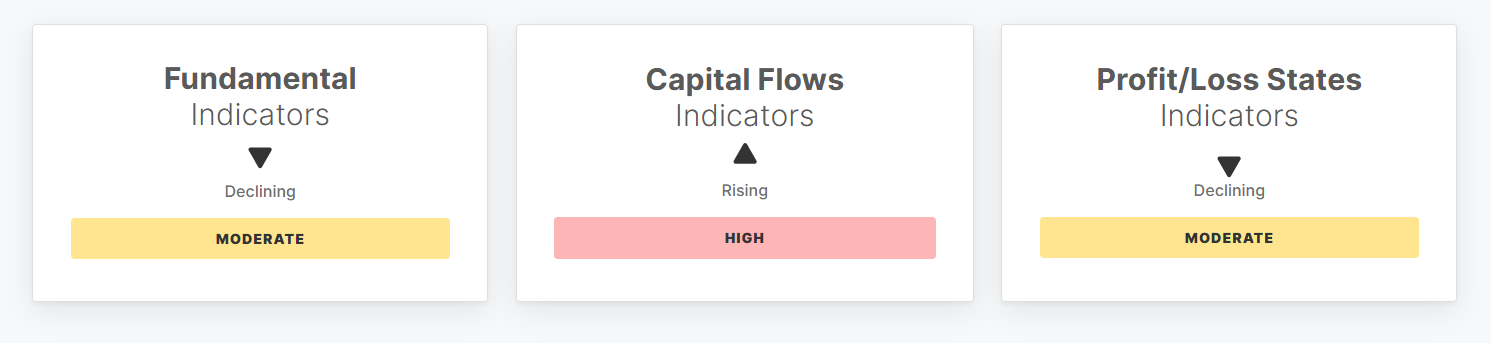
Who was carrying the losses?
Glassnode’s short-term holder net unrealized profit/loss measure fell to −7.4%, indicating that this group was underwater in aggregate. The share of Bitcoin supply in profit declined from 60.4% to 55.3%. Meanwhile, monthly realized-cap growth slowed from 0.43% to 0.04%, which Glassnode interpreted as a marked slowdown in new capital entering the network.
Activity had not disappeared: entity-adjusted daily transfer volume rose 3.6% to $5.4 billion, and daily active addresses stood at roughly 659,700. Activity and profitability, however, answer different questions. The former shows that Bitcoin was still moving; the latter shows the pressure on holders’ positions.
Glassnode’s assessment was that ETF selling, speculative long-position liquidations and broader risk aversion had combined in the decline. That is an interpretation of the available indicators, not proof that any one factor caused the price move. Lower leverage removes one source of risk, but the report left open whether ETF outflows and losses among recent buyers would continue—and whether $64,000 would hold.