
Originally reported by 深潮 TechFlow on November 12, 2026, at 09:58 (UTC+8), in its translation of a report jointly published by Bitcoin Security Consortium and Presidio Bitcoin.
A quantum computer has not broken Bitcoin. The report’s concern is narrower and forward-looking: a sufficiently capable machine running Shor’s algorithm could derive a private key from an exposed public key, threatening Bitcoin’s signature mechanism. That would not, by itself, change Bitcoin’s issuance schedule or supply cap.
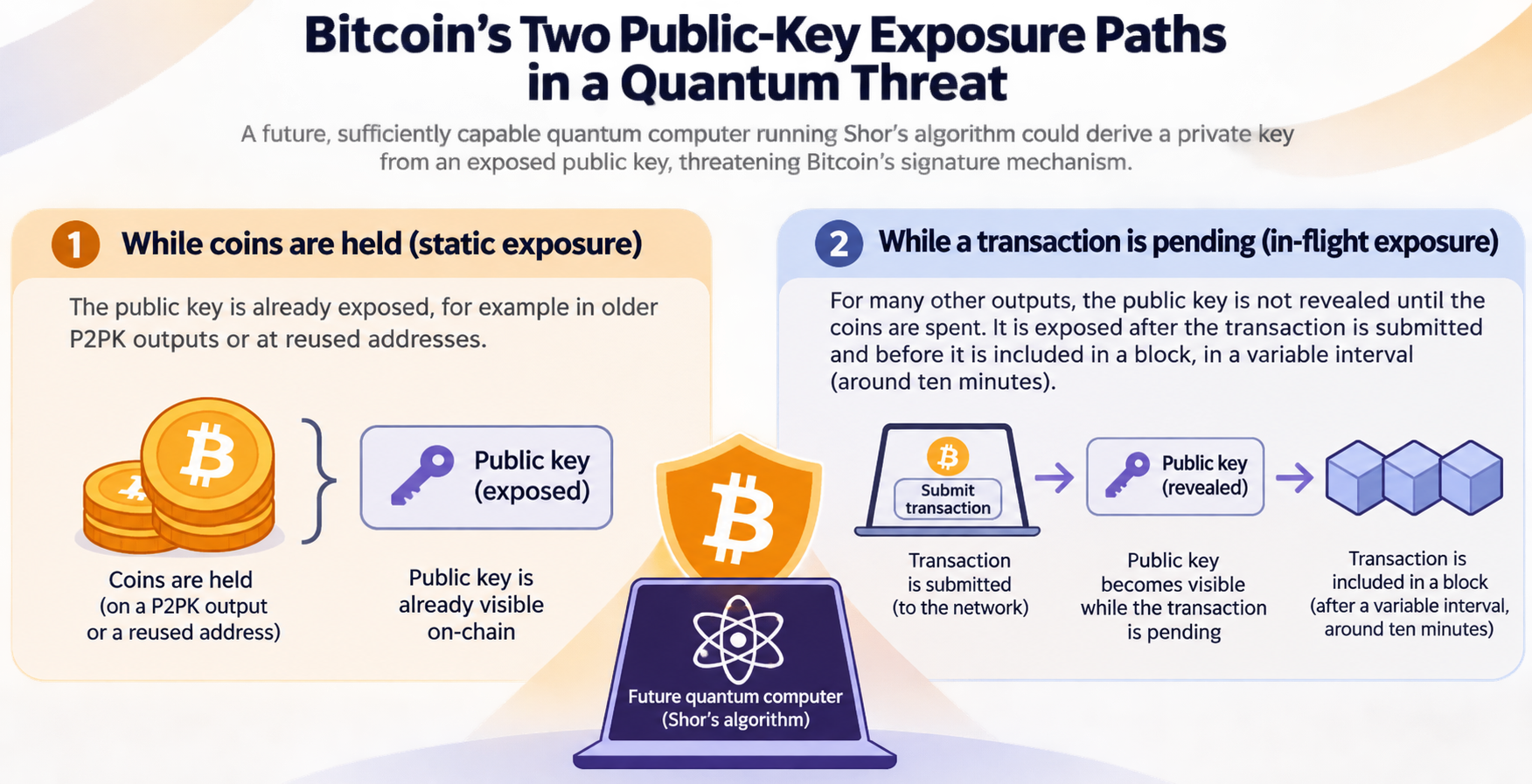
Two ways a public key can be exposed
While coins are held: Some older pay-to-public-key (P2PK) outputs and coins held at reused addresses have exposed public keys. Project Eleven estimated that, if a capable quantum computer existed at the time of the report, about 7.1 million BTC, or roughly 35% of total supply, could be at risk. The report says about three-quarters of that amount was held at reused addresses, largely associated with major exchanges. Moving those funds to unused addresses could reduce this exposure without a network rule change.
P2PK coins pose a harder question because many may no longer have an owner able to move them. The report gives different approximate P2PK figures in different sections: about 1.8 million BTC in one estimate, and about 1.7 million BTC across 20,000 addresses in its discussion of possible responses. It estimates that 1.1 million BTC of the latter amount belongs to Satoshi Nakamoto. These are estimates, not a count of coins known to be lost.
While a transaction is pending: For many other outputs, the public key is not revealed until the coins are spent. A transaction can then expose it between submission and inclusion in a block. The report describes this as a window of around ten minutes, not a guaranteed interval. It cites a Google estimate that a hypothetical fast quantum device might derive one private key in as little as nine minutes. That is a modeled attack, not a demonstrated theft.
How close is the threat?
The report describes advances in error correction and proposed improvements to Shor’s algorithm, but says no cryptographically relevant quantum computer existed at publication. It cites 48 error-corrected logical qubits in a publicly demonstrated system, against an estimate of at least roughly 1,200 needed to break Bitcoin’s elliptic-curve cryptography. The algorithm designs and hardware estimates are not the same as a machine performing the attack.
Avoiding address reuse is an available precaution, but it does not eliminate the exposure that occurs when a transaction reveals its public key. Longer-term proposals include post-quantum signatures. The report points to Blockstream’s SHRINCS proposal, tested on Liquid in March 2026, with a Bitcoin Improvement Proposal published with contributors in August 2026. Its formal security proof was still in progress, and Bitcoin-wide deployment would require a soft fork.
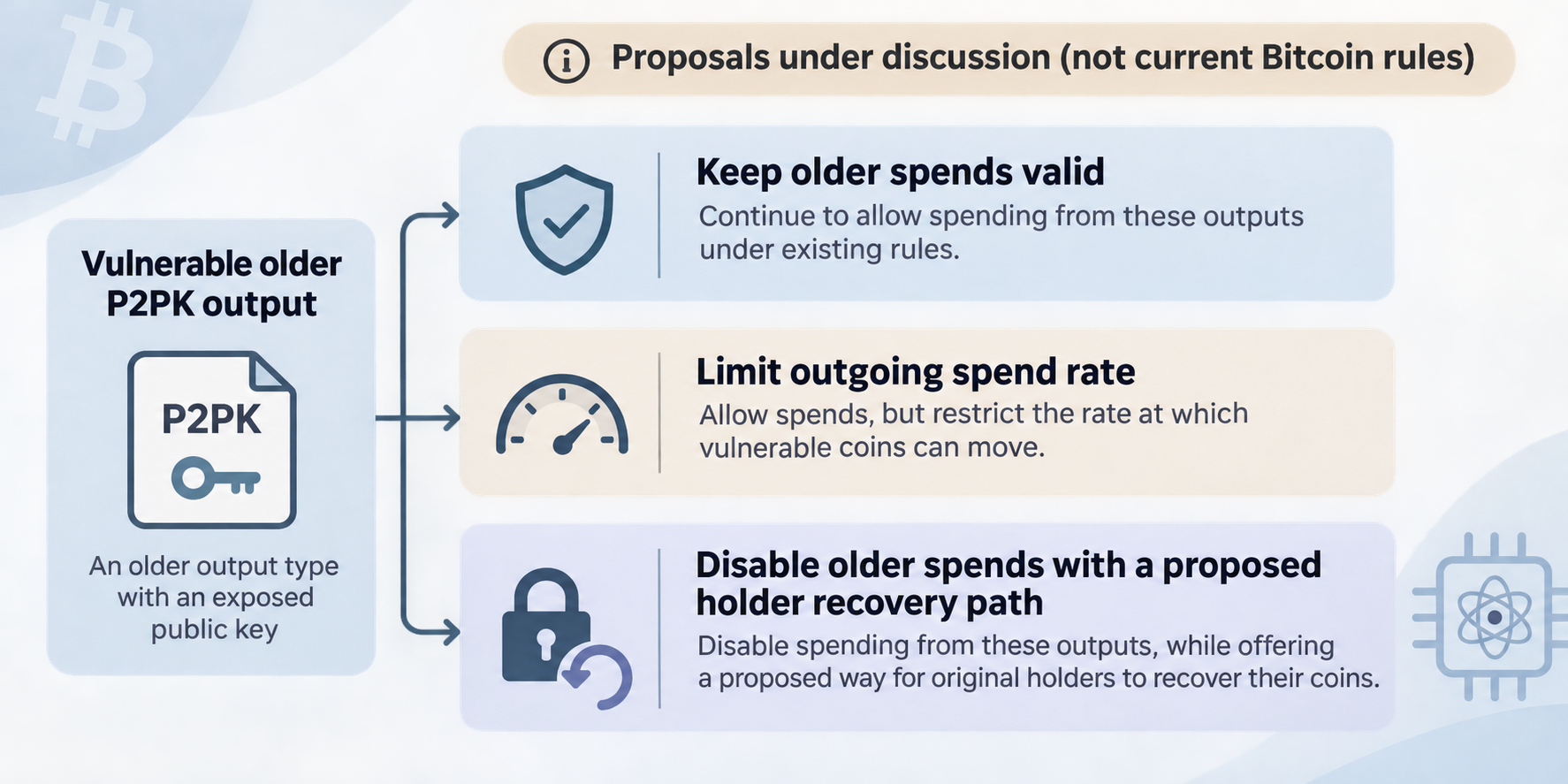
There is no agreed rule for the potentially lost P2PK coins. Presidio Bitcoin outlines three approaches under discussion: leave older spends valid, limit the rate at which vulnerable coins can move, or disable older spends while offering original holders a proposed recovery path. Each would raise different ownership and network-consensus questions. The practical distinction is between reducing exposure where holders can act now and deciding what, if anything, the network should change later.
Source: techflowpost.com (originally published 2026-11-12 09:58 UTC+8)