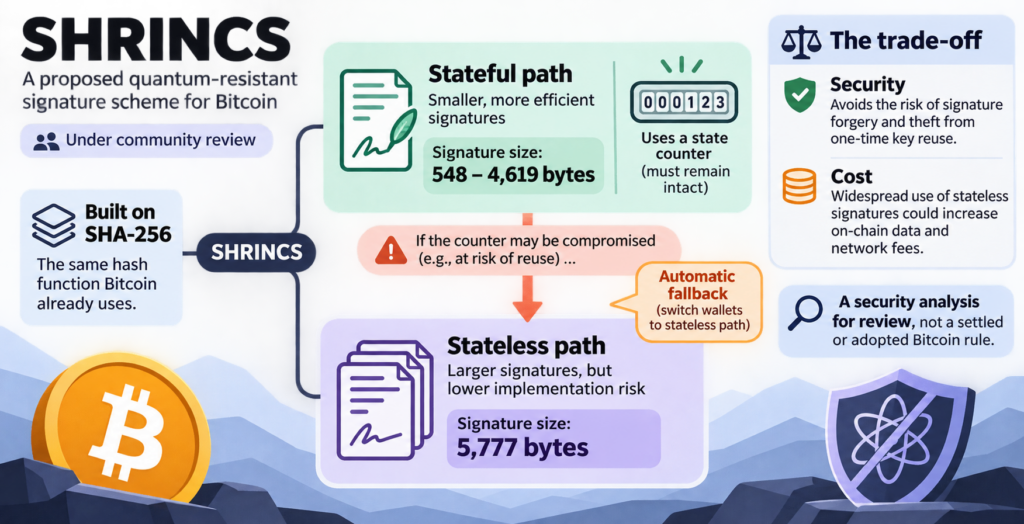
On November 20, 2026, TechFlow reported, citing Decrypt, that Blockstream research head Jonas Nick, researcher Mikhail Kudinov and others had published a security analysis of SHRINCS, a proposed quantum-resistant signature scheme for Bitcoin. They sought community review of both the scheme and the analysis. It was not reported as an adopted Bitcoin rule.
SHRINCS builds on SHA-256, which Bitcoin already uses. Its stateful path offers smaller, more efficient signatures. Its stateless path produces larger signatures but carries less implementation risk. The reported sizes range from 548 to 4,619 bytes for stateful signatures, compared with 5,777 bytes for stateless signatures.
The distinction matters because the stateful path depends on keeping a counter intact. Nick said wallets should switch automatically to the stateless path if that counter may be compromised: reusing a one-time key could allow a forged signature and the theft of funds.
That fallback has a cost. Nick also warned that widespread use of stateless signatures could increase on-chain data and network fees. SHRINCS therefore presents a security trade-off for review, not a settled answer for Bitcoin.