
Democrats won both houses of Congress in the November 2026 midterms, but that does not give them control of the US Strategic Bitcoin Reserve. President Donald Trump created the reserve by executive order. A successor could revoke it without a vote in Congress. The reverse is true of the GENIUS Act: a future president could change how regulators administer the stablecoin law, but could not repeal it by executive order.
That distinction matters more than when a policy was announced. As of November 26, 2026, the 36 measures under review ranged from bills that had never become law to court judgments that a change of administration could not reopen.
What changes when the new Congress takes office?
Beginning January 3, 2027, Democrats can set committee agendas, investigate agency decisions and decline to advance bills. The Senate can also refuse to confirm nominees to the Securities and Exchange Commission (SEC) and Commodity Futures Trading Commission (CFTC). Democratic lawmakers have said they intend to investigate, among other matters, the conditional federal trust charter granted to World Liberty Trust, an affiliate of the Trump family’s World Liberty Financial. A planned investigation is not a finding of wrongdoing.
Trump retains the veto through January 2029. Democrats fell well short of the two-thirds majorities needed to override it: 67 votes in the Senate and 290 in the House. They can therefore stop an unfinished bill more readily than they can overturn a law Trump supports. A Democratic administration taking office in January 2029 is a separate, hypothetical outcome.
The Bitcoin reserve: ending the policy is not the same as selling the coins
Executive Order 14233, signed March 6, 2025, established the Strategic Bitcoin Reserve and a separate Digital Asset Stockpile. The reserve policy calls for the government to retain bitcoin obtained through criminal or civil forfeiture rather than routinely sell it. As of November 26, 2026, the government had announced no open-market purchase plan.
BitcoinTreasuries estimated that the government held about 328,372 BTC. That is an estimate of government holdings, not an official reserve balance or a count of coins available for sale. Revoking the order would end the presidential direction to retain forfeited bitcoin. It would not settle outstanding forfeiture proceedings or eliminate obligations to compensate victims.
Neither of the reserve bills changed that position. Senator Cynthia Lummis’s BITCOIN Act, S. 954, proposed federal purchases over several years. The American Reserve Modernization Act cleared the House Financial Services Committee 28–21 on September 16, 2026. Neither had become law.

Guidance can change faster than a final rule
On March 20, 2025, SEC staff said that the proof-of-work mining activities they described did not constitute an offer or sale of securities. That view matters to miners, but it was not a commission vote or a statutory exemption. Staff positions on certain stablecoins, staking arrangements and noncustodial interfaces have the same limitation: a new leadership team can withdraw them. CFTC staff assurances covering specified uses of digital assets as margin or certain passive wallet software are likewise conditional, not permanent licenses.
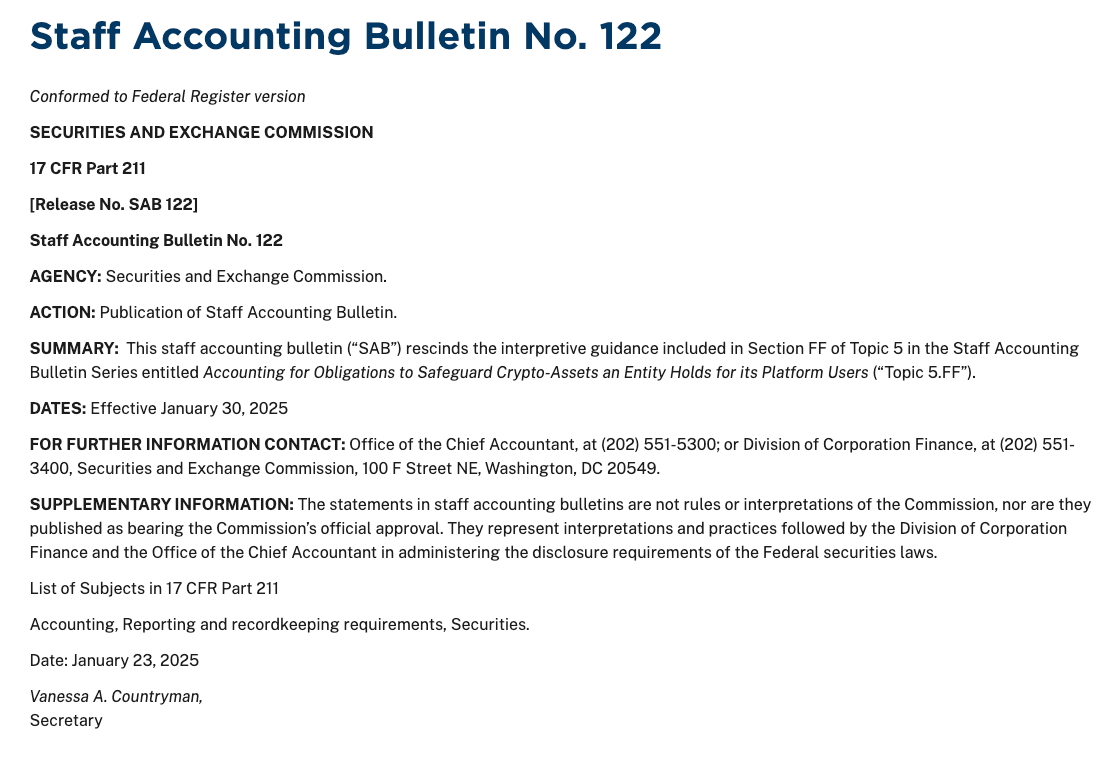
Banks face a similar distinction. In January 2025, SEC Staff Accounting Bulletin 122 rescinded SAB 121, which had required companies safeguarding customers’ crypto assets to record a corresponding liability. SEC staff could revisit that treatment, although banks have since built custody products and hired teams around it. By contrast, the Office of the Comptroller of the Currency (OCC) and the Federal Deposit Insurance Corporation used a final rule, effective June 9, 2026, to remove reputation risk from their supervisory framework and prohibit regulator-driven denial of banking services. Revoking the executive order behind that policy would not repeal the rule. Replacing it would ordinarily require public comment and a reasoned explanation, a process that could take 12 to 24 months and face judicial review.
Several other measures had not reached that stage. The SEC’s August 18, 2026, Regulation Crypto Assets proposal contemplated a $5 million startup exemption and fundraising tiers capped at $20 million and $75 million. Comments closed October 20; the exemptions were not in force. The CFTC’s work on leveraged, margined or financed retail crypto transactions was at the earlier advance-notice stage. It did not give the agency general licensing authority over fully paid spot trading. And the Labor Department’s rule on alternative assets in 401(k) plans was under White House review in November, not yet in effect.
Stablecoin law is harder to change than stablecoin supervision
Trump signed the GENIUS Act, Public Law 119-27, on July 18, 2025. It established a licensing framework for payment stablecoin issuers, required high-quality reserves and restricted issuers from paying yield directly to holders. The Senate passed it 68–30, with 18 Democrats in favor. The House passed it 308–122, including 102 Democratic votes.
The law takes effect on the earlier of two dates: 18 months after enactment or 120 days after final implementing regulations are issued. Regulators missed their July 18, 2026, rulemaking deadline, leaving January 18, 2027, as the effective date under the 18-month provision.
There is still room to change how the law works. About 13 implementing measures remained proposals in November 2026, including Treasury’s principles for deciding whether state supervision is substantially similar to federal supervision. Treasury’s interim final rule on the state certification procedure, however, took effect September 30, 2026. The OCC also issued a final rule, effective January 18, 2027, setting a $5 million minimum capital floor and specifying stress tests and liquidity buffers. A future regulator could propose different requirements within the statute. Removing the statute itself would require another act of Congress.
Congress also placed a lasting limit on tax regulation. On April 10, 2025, Trump signed the Congressional Review Act resolution overturning the IRS rule that would have treated certain DeFi participants as brokers for transaction reporting. Without new congressional authorization, the agency cannot issue a substantially similar rule. The resolution did not repeal Form 1099-DA reporting for custodial brokers, which began with the 2025 tax year.
An ETF listing, a bank charter and a closed case have different protections
On July 29, 2025, the SEC approved in-kind creation and redemption for bitcoin and ether exchange-traded products. Authorized participants could deliver or receive the underlying asset rather than transact only in cash. Reversing that decision would impose costs on funds already using the mechanism.
A separate SEC decision on September 17, 2025, approved generic listing standards for qualifying commodity trust shares on Nasdaq, Cboe BZX and NYSE Arca. A future SEC could revisit the standards for listings without automatically delisting products investors already hold. Morgan Stanley counted about 140 US-listed crypto-related exchange-traded products, roughly 40 of them single-asset spot products. Existing investors make forced delisting costly; they do not make listing standards immutable.
For federal trust charters, the dividing line is final approval. Ripple received final OCC approval in October 2026; Circle, BitGo and Coinbase followed in November. Revoking a final charter requires cause. Conditional approvals, including World Liberty Trust’s, can be delayed or denied final confirmation. The Independent Community Bankers of America sued in October 2026 to challenge the OCC’s authority to grant such charters; the challenge itself did not revoke them.
Court outcomes offer a sharper boundary. The SEC could in principle reopen an investigation it closed without bringing charges, subject to applicable time limits. It cannot bring the same claim again after a dismissal with prejudice, as in the cases against Coinbase, Kraken and Binance. Both sides dropped their appeals in the Ripple case in August 2025, leaving the $125 million penalty intact, not the proposed $50 million settlement amount. Delivered presidential pardons, including those for Ross Ulbricht, the BitMEX founders and Binance founder CZ, likewise cannot be withdrawn by a successor.
What remains for Congress to decide?
The CLARITY market-structure bill illustrates the limit of agency action. It passed the House 294–134 on July 17, 2025, but a September 15, 2026, Senate vote to end debate on taking it up failed 49–50, short of the 60 votes required. Orrick identified officials’ crypto holdings and stablecoin yield as central points of disagreement. Troutman Pepper Locke noted that agencies cannot use their own rules to reproduce key parts of the bill, including licensing for spot-market intermediaries and priority for customer property in bankruptcy.
Other unfinished bills can also stall without a repeal vote. The House passed a retail central bank digital currency ban, but the Senate did not agree to it; the operative federal prohibition still rests on Executive Order 14178. The Digital Asset Tax Certainty Act cleared the House Ways and Means Committee 38–5 on September 16, 2026, but neither chamber had voted on it.
The midterms changed who can advance legislation and scrutinize regulators. They did not change who holds forfeited bitcoin, cancel a fund listing or reopen a judgment. For each policy, the useful questions are who has authority to change it and what would remain in place even if they did.