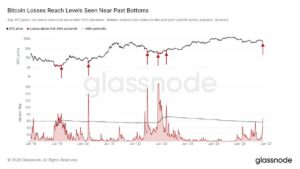
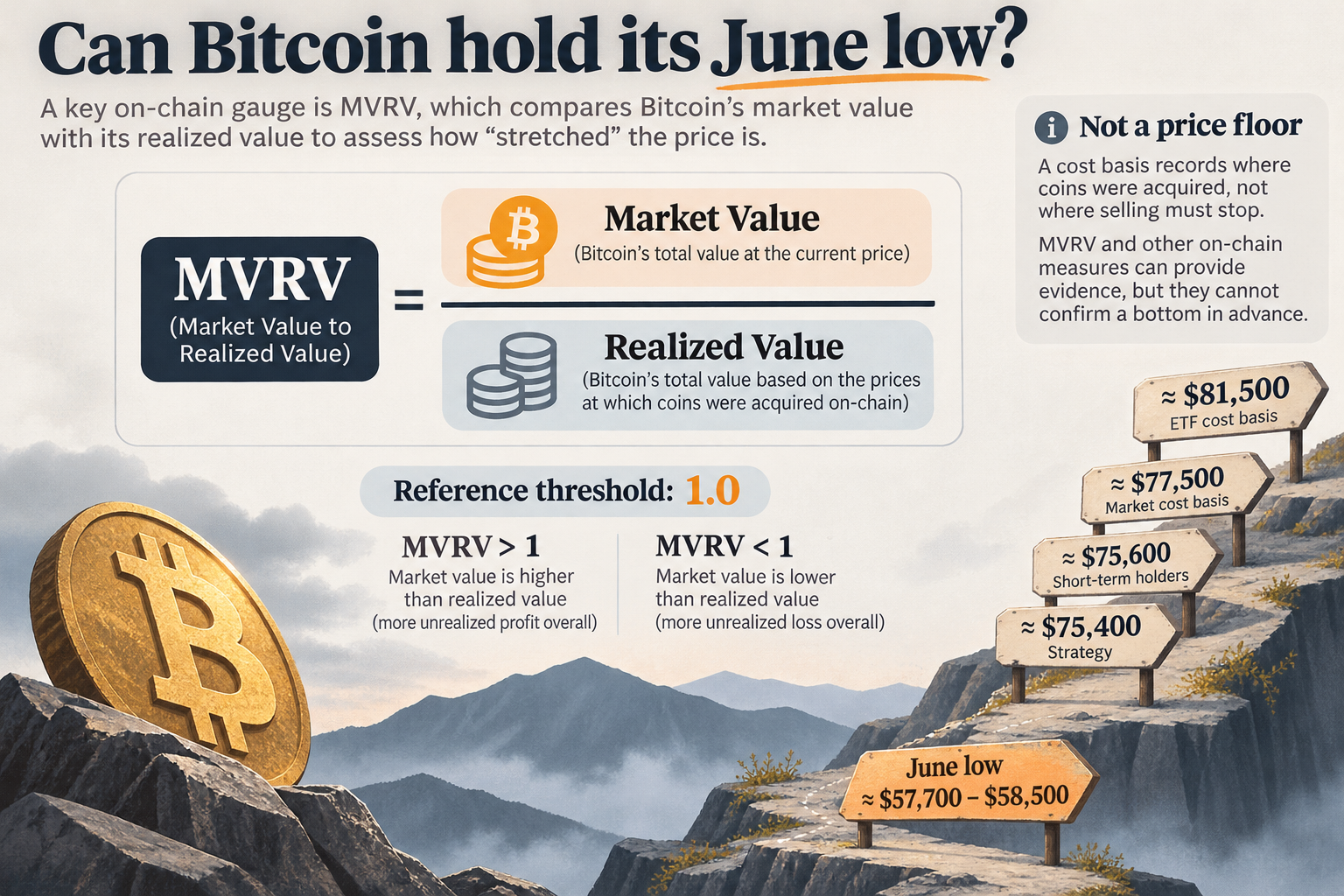
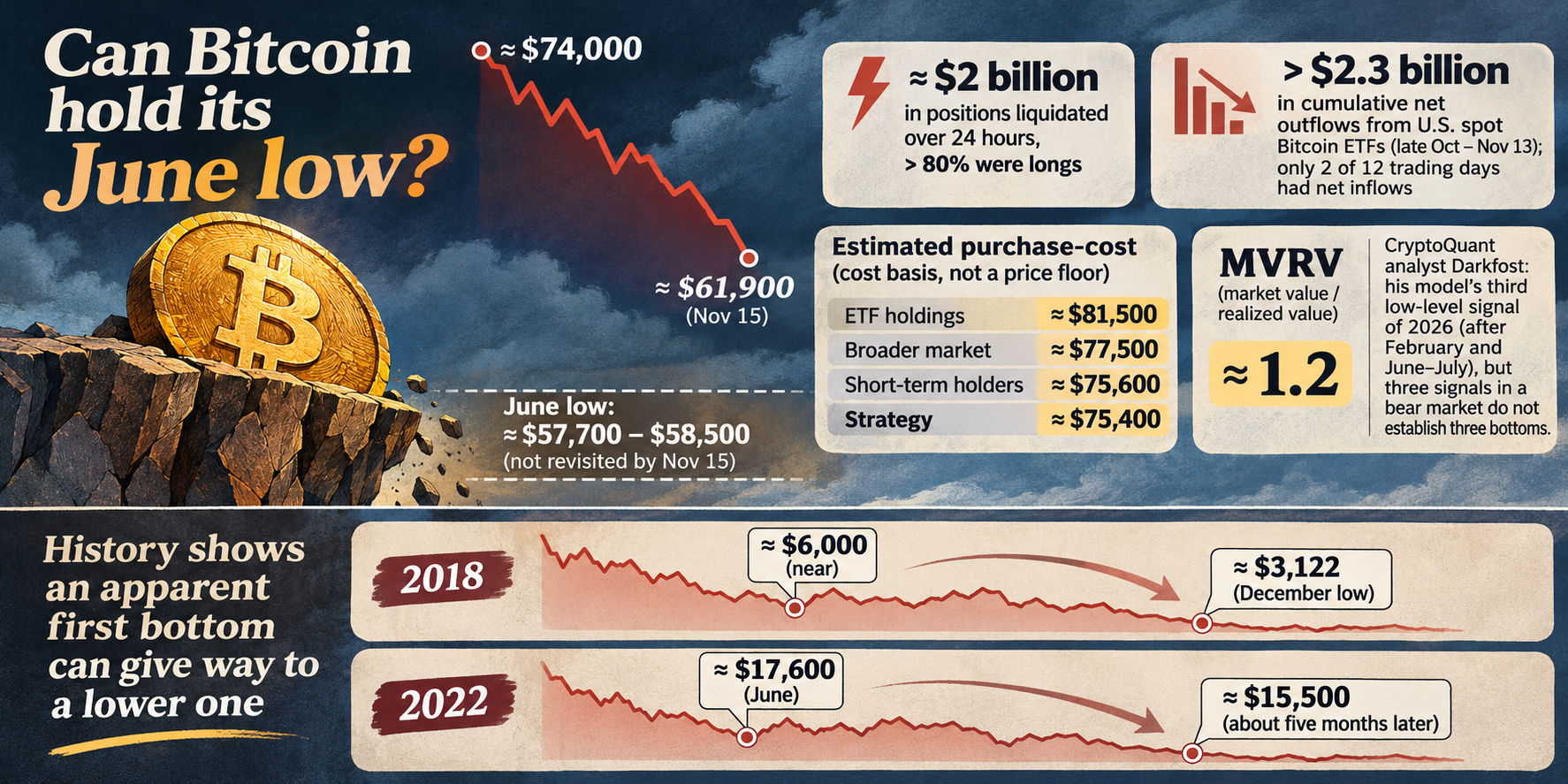
Can Bitcoin hold its June low? A report published on November 18, 2026, posed that question after Bitcoin fell from about $74,000 to a November 15 low near $61,900 in five days. The report put the June low at roughly $57,700–$58,500. That earlier range was close, but it had not been revisited by November 15.
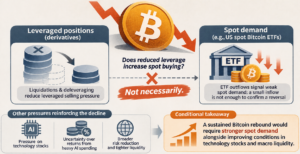
The report described pressure from both forced selling and weaker demand. It said nearly $2 billion in positions were liquidated over 24 hours, with long positions accounting for more than 80%. It also reported that U.S. spot Bitcoin ETFs had more than $2.3 billion in cumulative net outflows from late October through November 13; only two of the 12 trading days in that span had net inflows.
What does the cost-basis data show?
The report placed several estimated purchase-cost measures above the market price: about $81,500 for ETF holdings, $77,500 for the broader market, $75,600 for short-term holders and $75,400 for Strategy. These estimates suggest that many recent buyers were holding losses. They are not price floors: a cost basis records where coins were acquired, not where selling must stop.
The report also said MVRV—the ratio of Bitcoin’s market value to its realized value—had fallen to about 1.2. CryptoQuant analyst Darkfost called it his model’s third low-level signal of 2026, after signals in February and June–July. He cautioned that three signals in a bear market do not establish three bottoms.
Why history gives no definitive answer
The report compared two earlier declines. Bitcoin fell to about $17,600 in June 2022, then to about $15,500 after FTX’s collapse five months later. In 2018, a long period near $6,000 preceded a December low around $3,122. Both examples show that an apparent first bottom can give way to a lower one; neither establishes that it will happen again.
Galaxy research head Alex Thorn’s framework looks for a bottom roughly 12–13 months after a peak, with MVRV below 1 and price below realized price. The report said the time condition had been met by November, but the valuation conditions had not. Thorn also noted that this cycle’s peak MVRV was lower than in earlier cycles, so a bottom need not reach the same depth. Galaxy’s scenarios ranged from $51,000 to $30,000, with a $40,000–$46,000 base case—not a confirmed destination.
The June low was therefore a level to watch, not a proven floor. ETF flows and on-chain measures could offer further evidence, but historical patterns and model thresholds cannot settle the question in advance.