As reported on November 18, 2026, MARA Holdings had disclosed sales of about 40,581 BTC for roughly $3 billion so far that year. The change raises a question: why would a miner that once pledged to keep all the Bitcoin it mined sell so much of its reserve?
The immediate answer was financing. MARA used Bitcoin as collateral to borrow dollars for a planned energy acquisition, then sold Bitcoin to repay the loans. It had also sold Bitcoin earlier in the year to retire convertible debt.
From accumulating Bitcoin to funding other needs
In July 2024, MARA adopted a policy of retaining all the Bitcoin it mined and buying more when opportunities arose. Its holdings reached 44,893 BTC by year-end. The policy began to loosen in 2025, when the company allowed sales of newly mined Bitcoin. In 2026, it also began selling Bitcoin already on its balance sheet.
Between March 4 and March 25, 2026, MARA sold 15,133 BTC for about $1.1 billion. It then spent about $913 million to repurchase roughly $1 billion in principal of two zero-coupon convertible notes. In the first nine months of the year, it mined 6,916 BTC and sold about 26,984 BTC. Its holdings stood at 34,012 BTC at the end of September, including 14,752 BTC available for use without first releasing collateral or loans.
The Long Ridge financing sequence
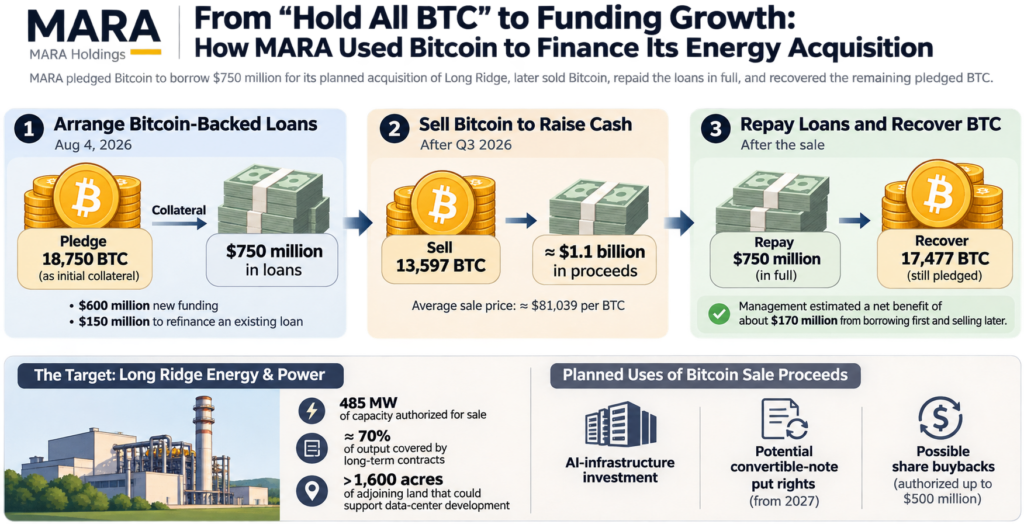
MARA’s proposed acquisition of Long Ridge Energy & Power had an enterprise value of about $1.5 billion, including up to roughly $900 million of debt it expected to assume. On August 4, MARA arranged two Bitcoin-backed loans totaling $750 million. Of that amount, $600 million was new funding and $150 million refinanced an existing loan. The initial collateral was 18,750 BTC.
After the third quarter ended, MARA sold 13,597 BTC at an average price of about $81,039, raising roughly $1.1 billion. It used $750 million to repay both loans in full and recovered the 17,477 BTC still pledged against them. Management estimated a net benefit of about $170 million from borrowing first and selling later.
That outcome depended on the price path. The loans gave MARA access to dollars without immediately selling the pledged Bitcoin, but also carried interest and the risk of having to add collateral if Bitcoin’s price fell. Repaying MARA’s acquisition loans did not eliminate the existing Long Ridge debt contemplated in the deal.
U.S. federal energy regulators approved the acquisition on November 4. When MARA reported results on November 9, it still expected the transaction to close in the following weeks; approval was not the same as a completed acquisition.
What the reserve is being used to build
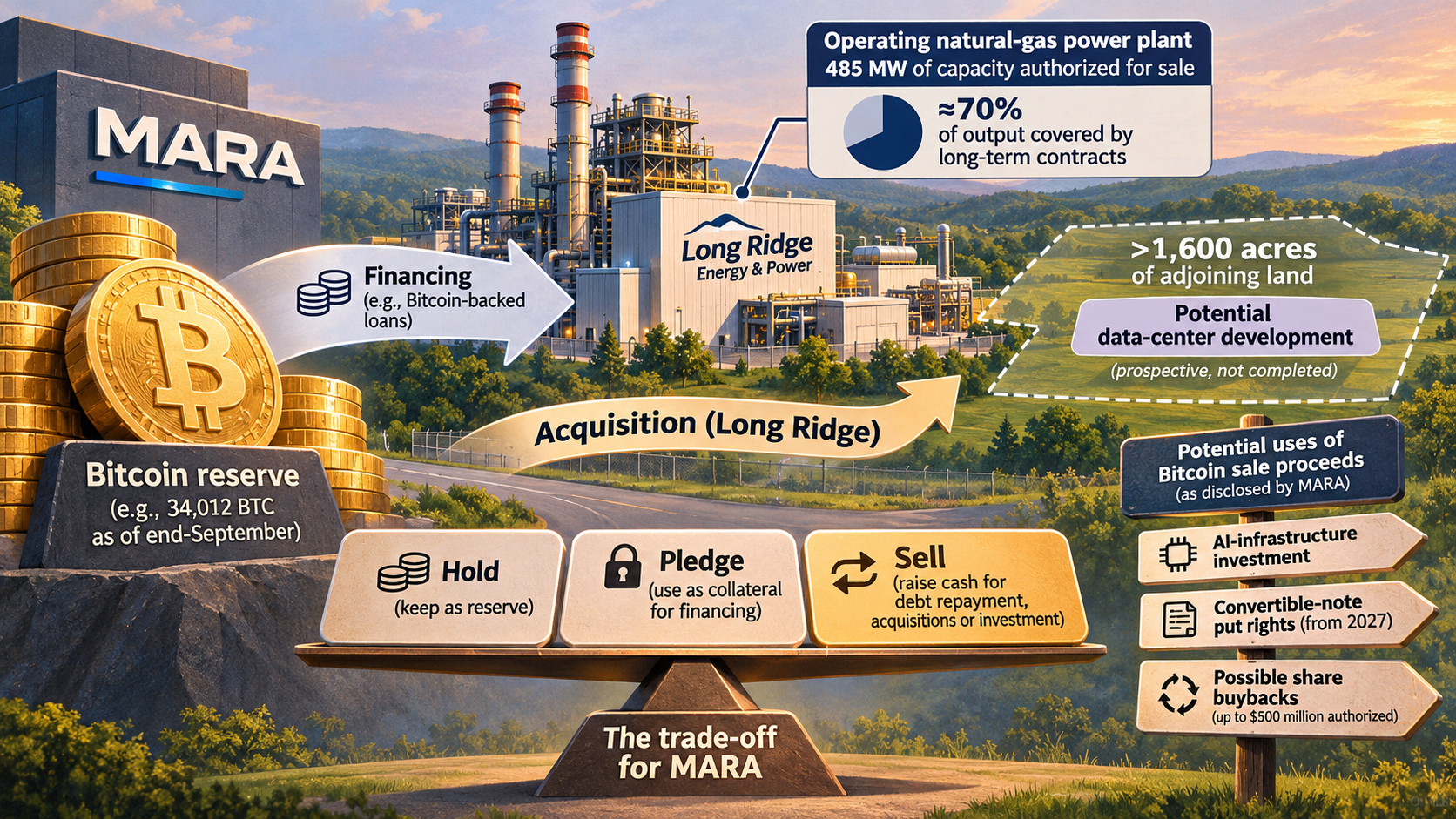
Long Ridge owns an operating natural-gas power plant in Ohio with 485 megawatts of capacity authorized for sale. According to MARA, long-term contracts cover about 70% of its output. The transaction also includes more than 1,600 acres of adjoining land that could support data-center development.
Those contracts offer a potential source of power-sale revenue, but they also mean not all of the plant’s capacity is freely available for new computing projects. Separately, MARA said it hoped to sign two data-center leases by the end of 2026, while acknowledging that signing could slip into 2027. Prospective projects and leases are not yet cash receipts.
MARA’s board also authorized up to $500 million in share repurchases on November 9; the authorization does not require the company to spend the full amount. MARA identified AI-infrastructure investment, potential convertible-note put rights from 2027 and possible buybacks as future uses for proceeds from Bitcoin sales.
The trade-off is now visible. Bitcoin reserves can be held, pledged for financing or sold to meet costs. How much MARA ultimately keeps will depend in part on when its energy and data-center projects generate cash—and how much it must spend before they do.