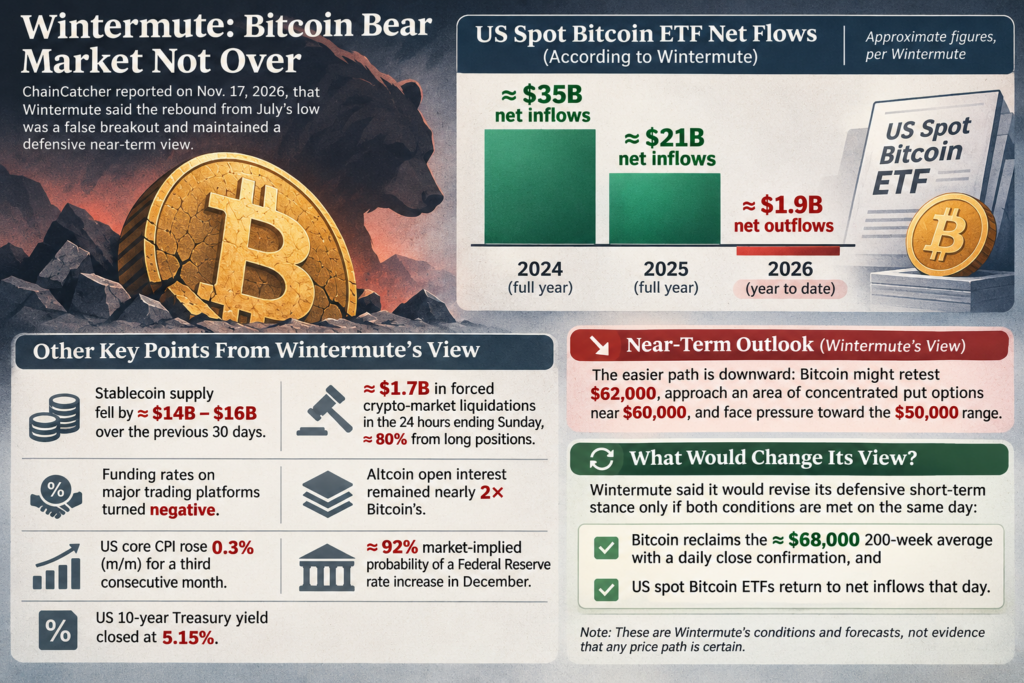
In reporting published on November 17, 2026, ChainCatcher relayed Wintermute’s view that Bitcoin’s bear market had not ended. Wintermute called the rebound from July’s low a false breakout. What would change its view?
Bitcoin had fallen below $80,000 and its 50-week moving average, then closed below its 200-week moving average, which Wintermute put near $68,000. Over the preceding week, Bitcoin fell 12.7% to close at $65,400. It briefly reached $62,000 on the preceding Saturday, its lowest level since July. Over the same period, the S&P 500 rose 2.5%, while Ether fell to about $1,800.
Wintermute also pointed to weaker fund flows. It said US spot Bitcoin ETFs had recorded about $1.9 billion in cumulative net outflows so far in 2026, compared with roughly $21 billion in net inflows in 2025 and $35 billion in 2024. It reported that stablecoin supply had fallen by about $14 billion to $16 billion over the previous 30 days.
The report cited approximately $1.7 billion in forced crypto-market liquidations in the 24 hours ending Sunday, around 80% of them long positions. Funding rates on major trading platforms had turned negative, while altcoin open interest remained nearly twice Bitcoin’s. It also noted a third consecutive monthly 0.3% rise in US core CPI, a market-implied probability of about 92% for a Federal Reserve rate increase in December, and a 5.15% close for the US 10-year Treasury yield.
Wintermute judged that the easier near-term path was downward: Bitcoin might retest $62,000, approach an area of concentrated put options near $60,000, and face pressure toward the $50,000 range. It said it would revise its defensive short-term stance only if Bitcoin reclaimed the roughly $68,000 200-week average with confirmation from a daily close and US spot Bitcoin ETFs returned to net inflows that day. Those are Wintermute’s conditions and forecasts, not evidence that any price path is certain.