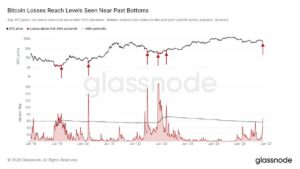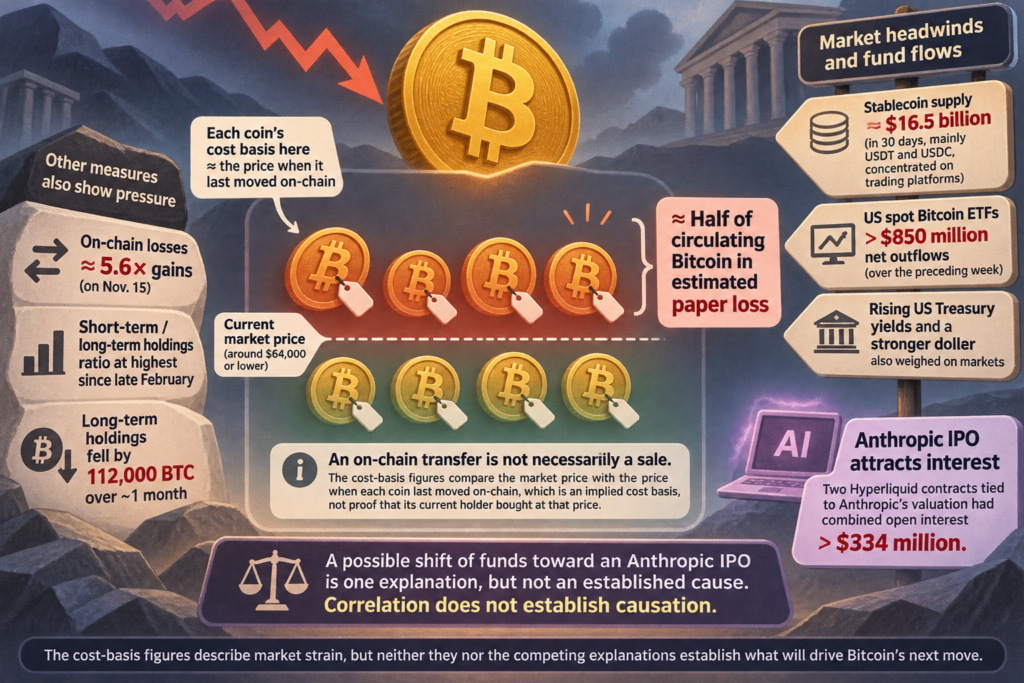
In a November 18, 2026 report, Bloomberg described Bitcoin trading around $64,000 or lower—roughly 50% below its high—without a clear rebound in buyers seeking to buy the dip. Glassnode estimated that about half of circulating Bitcoin was at a paper loss, compared with less than a quarter in late September, when Bitcoin closed at $86,600.
That estimate compares the market price with the price when each coin last moved on-chain. It is a measure of implied cost basis, not proof that its current holder bought at that price. A transfer does not necessarily mean a sale.
Other measures pointed to pressure. Among Bitcoin moved on-chain on November 15, the total dollar value of estimated losses was about 5.6 times the value of gains—the widest gap since mid-July. The ratio of short-term to long-term holdings reached its highest level since late February, while long-term holdings fell by 112,000 BTC over roughly a month.
Glassnode also reported that the stablecoin supply it tracks fell by about $16.5 billion in the 30 days through November 15, mainly in USDT and USDC, with the declines concentrated on trading platforms. US spot Bitcoin ETFs recorded more than $850 million in net outflows over the preceding week. Bloomberg noted that the decline began before the weekend’s forced liquidations and that rising US Treasury yields and a stronger dollar also weighed on markets.
Interest in a potential Anthropic IPO offered another possible explanation, but not an established cause. Two Hyperliquid contracts tied to Anthropic’s valuation had combined open interest above $334 million. Although many participants had previously traded major crypto futures, the available data did not show whether they sold crypto to fund those positions. Binance co-founder Changpeng Zhao raised a shift of funds toward an Anthropic IPO as one possibility while cautioning that correlation does not establish causation.
The cost-basis figures describe market strain, but neither they nor the competing explanations establish what will drive Bitcoin’s next move.